科研亮点:Improved Amplitude Scintillation Index IS4c with Suppression of GNSS Receiver Background Noise Effects
1 Abstract
Ionospheric amplitude scintillation is particularly common in equatorial and low-latitude regions, affecting the performance of GNSS precise positioning services. S4c index derived from carrier-to-noise ratio data released by the geodetic GNSS receivers can be used to monitor ionospheric amplitude scintillation. However, this index is susceptible to GNSS receiver background noise like the observation noise and multipath effect, especially in low elevation angle conditions, which can result in misjudgment of scintillation event. In this study, by suppressing the GNSS receiver background noise using the method of de-mean and adaptive weight coefficient adjustment, we propose an improved amplitude scintillation index as IS4c based on S4c. Experiments using the data derived from Ionospheric Scintillation Monitoring Receiver (ISMR) in Hainan of China show that the average of misjudgment rates of ionospheric scintillation for IS4c and S4c are 3.7% and 11.7%, respectively, and the improvement rate of IS4c over S4c is 69.9% in 2023. Further experiments using consecutive 30 days data in 2023 from 20 GNSS stations equipped with four mainstream geodetic receivers (JAVAD, LEICA, SEPTENTRIO, and TRIMBLE) indicate that the average improvement rates of IS4c over S4c for the four receivers are 63.6%, 69.2%, 61.3%, and 61.4%, respectively. Meanwhile, two-dimensional IS4c maps generated by GPS L1 signals data collected at 1363 stations in the range of 45°S-45°N and 60°E-180°E during the Tonga volcanic eruption on January 15, 2022 show better ionospheric scintillation monitoring performance than those of S4c. In addition, we also applied the IS4c in the construction of the Improved Receiver Tracking Error Stochastic (Impr_RTES) model for GPS Precise Point Positioning (PPP). Experiment results indicate that compared with the Elevation Angle Stochastic (EAS) model, the Impr_RTES of IS4c can improve the positioning accuracy of PPP by 15.5%, 26.3%, and 36.2% in the east, north, and up directions, respectively.
2 Experimental validations
Figure 1 presents the time series of S4, S4c, IS4c and elevation angle for different GPS satellites at HNLW station on February 20, February 28, March 10, and April 17 in 2023. It can be seen that severe ionospheric scintillations occurred during around 12:00-20:00 UTC on these four days. According to the numerical changes of S4, the ionosphere is in the quiet phase around 0:00 to 12:00 UTC and from 20:00 to 24:00 UTC on all four days. During these two quiet periods, some S4c points show significant fluctuations with their values exceeding the traditional threshold 0.2. By observing the portions where S4c exceeds the threshold 0.2, it is found that the elevation angles at the corresponding moments are generally distributed around 15°, indicating a certain correlation between the value of S4c and the value of elevation angle. Different from S4c, the fluctuations of IS4c from 0:00 to 12:00 and 20:00 to 24:00 UTC generally coincide with S4, both remaining below the ionospheric scintillation threshold 0.2. Additionally, during ionospheric scintillation periods, IS4c maintains consistency with both S4c and S4 indexes, rapidly reflecting and presenting the entire ionospheric scintillation phase.
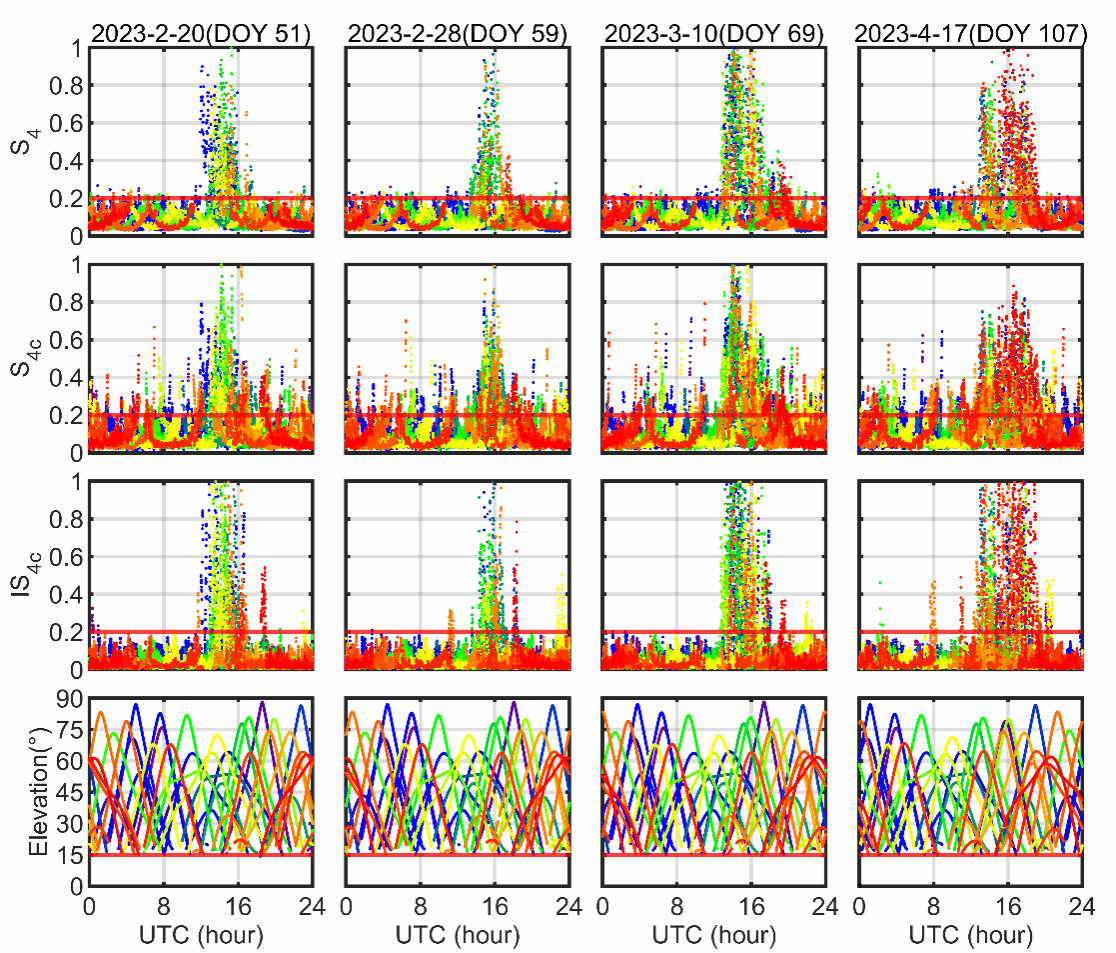
Fig.1 Time series of S4, S4c, IS4c and elevation angle for different GPS satellites at HNLW station on February 20, February 28, March 10, and April 17 in 2023
Using HNLW station data from January 1 to September 30, in 2023, Figure 2 presents the statistical results of ionospheric scintillation misjudgment rate of IS4c (red curve) and S4c (green curve). Corresponding improvement rate of IS4c over S4c (blue curve) is also shown in the figure. As depicted in Figure 2, the misjudgment rates of IS4c are basically less than 5% across all data points and the calculated average value is 3.7%. The misjudgment rate of S4c, with an average misjudgment rate of 11.7%, is approximately three times the average misjudgment rate of IS4c. The improvement rate of IS4c over S4c exceeds 70% for most data, and the average of improvement rate is 69.9%.
The above results indicate that the misjudgment rate of IS4c is significantly lower than that of S4c, with an average improvement rate as high as 69.9%. The IS4c can mitigate the effect of receiver background noise on S4c, effectively identify ionospheric scintillation events. As shown in the figure, the fluctuation trends of the two misjudgment rates are generally consistent. Significant fluctuations occur in the Spring (March and April) and Autumn (August) in northern hemisphere, during which the misjudgment rate curves all exhibit drastic oscillations. The increase in the misjudgment base of S4c leads to a certain degree of decline in the improvement rate. In other months, the two misjudgment rates show a stable trend with relatively small values, and most improvement rates exceed around 70%.
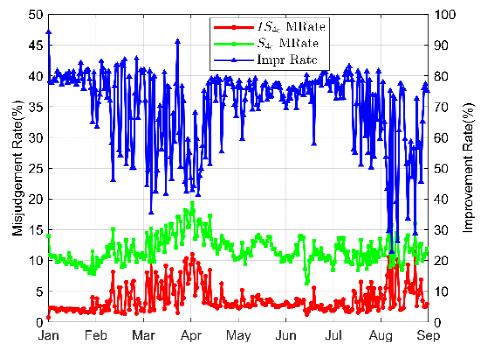
Fig.2 Misjudgment rates of IS4c and S4c and the improvement rates of IS4c over S4c at HNLW station in 2023
Figure 3 further shows the improvement analysis of IS4c over S4c for 20 stations during consecutive 30 days from February 10 to March 11 in 2023. In the figure, each bar represents the improvement rate of IS4c over S4c on the corresponding day. The four subplots indicate the geodetic GNSS receiver types JAVAD, LEICA, SEPTENTRIO, and TRIMBLE, respectively. Statistical results indicate that the average improvement rates of IS4c over S4c for JAVAD, LEICA, SEPTENTRIO, and TRIMBLE are 63.6%, 69.2%, 61.3%, and 61.4%, respectively.
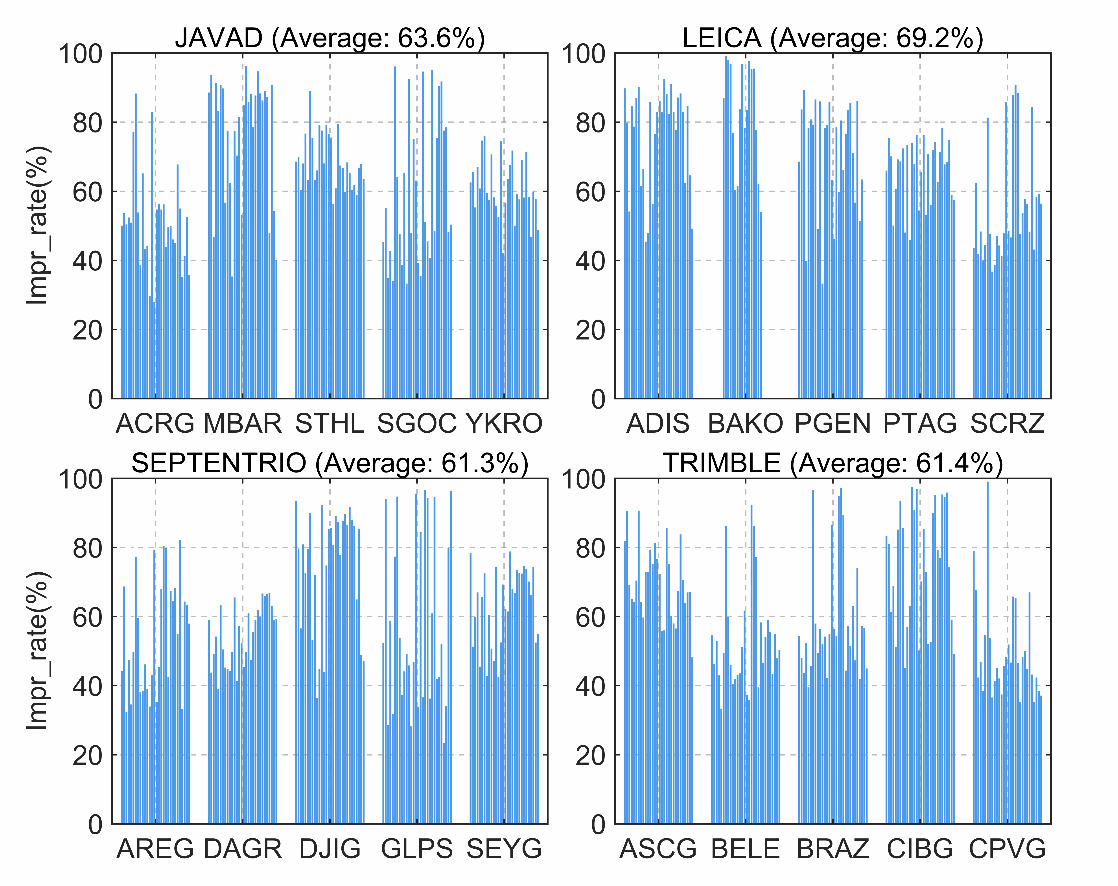
Fig.3 Improvement rates of IS4c over S4c for 20 stations equipped with four mainstream geodetic receivers (JAVAD, LEICA, SEPTENTRIO, and TRIMBLE) during consecutive 30 days from February 10 to March 11 in 2023
Figure 4 shows IS4c grid maps in ionospheric scintillation monitoring during Tonga volcanic eruption on 15 January 2022. Note that the magnitude range of IS4c in the figure is 0-0.4, which has a slight difference from S4c with 0-0.5. This difference is to ensure that the effective data of IS4c and S4c are as consistent as possible. Note that the percentages of IS4c < 0.4 and S4c < 0.5 are both 98.7%. As shown in subgraphs 1-4, the scintillation area near the equator gradually expanded from 06:00 UTC to 09:00 UTC. Subgraphs 5-8 indicate that the scope and intensity of ionospheric scintillation continues to increase until reaching their peak at 13:00 UTC. According to subgraphs 9-12, the ionospheric scintillation gradually dissipates westward as time progressed. From Figure 4, it can be seen that IS4c can suppress the influence of receiver background noise on S4c, optimize the misjudgment results of ionospheric scintillation in oceanic regions, and retain the drift and geomagnetic conjugate characteristics of ionospheric irregularities at low-latitudes. In addition, the scintillation monitoring results of IS4c is also generally consistent with those reflected by the ROTI maps during the Tonga volcanic eruption.
Figure 5 further shows the percentages of ionospheric irregularity event detected by the ROTI, IS4c, and S4c for the 12 grid maps (6:00-17:00 UTC) on 15 January 2022. The percentage values are calculated by the number of grids with ROTI > 0.5 TECU/min, IS4c > 0.2, and S4c > 0.2 divided by the number of valid grids, respectively. It also can be seen that compared with S4c, the number of ionospheric irregularity events reflected by the IS4c is more consistent with those reflected by the ROTI. Statistical results that the average values of the percentages of ionospheric irregularity event detected by the ROTI, IS4c, and S4c are 6.0%, 5.8% and 24.4%, respectively.
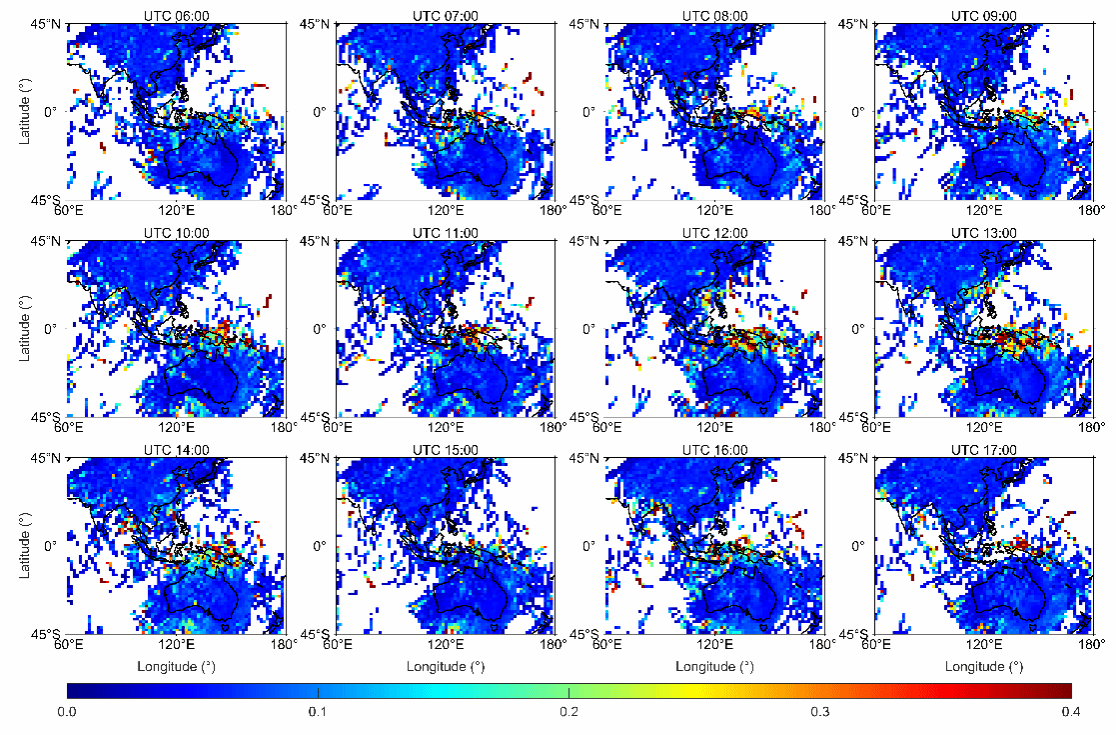
Fig.4 Using IS4c maps to monitor ionospheric scintillations during Tonga volcanic eruption on 15 January 2022
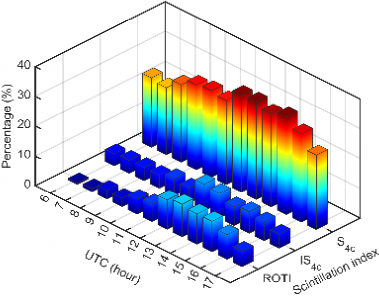
Fig.5 Percentages of ionospheric irregularity event detected by the ROTI, IS4c, and S4c for the 12 grid maps (6:00-17:00 UTC) maps on 15 January 2022
Figure 6 shows the comparison results of GPS kinematic PPP based on three stochastic models as EAS, Impr_RTES of S4c, and Impr_RTES of IS4c using the GPS data collected at HNLW station data on 13, 14, and 15 February in 2023, respectively. GPS signals during the three days are affected by ionospheric scintillation. In Figure 11, corresponding root-mean-square (RMS) statistics of GPS PPP are shown in the bottom of each positioning panel. Statistical results indicate that compared with EAS model, Impr_RTES of S4c and Impr_RTES of IS4c can improve positioning accuracy during strong scintillation phases. Under the weak scintillation conditions, the performance of Impr_RTES of IS4c and Impr_RTES of S4c is comparable to that of EAS.
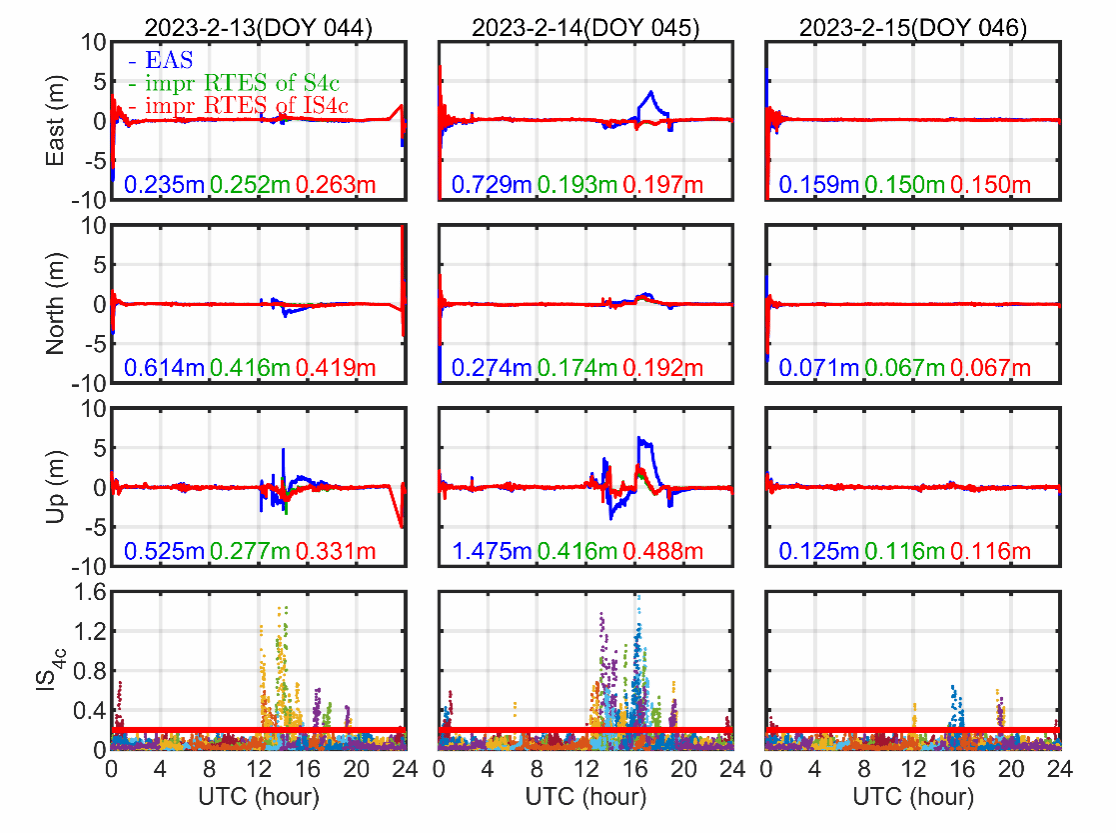
Fig.6 Positioning errors of the GPS single-frequency kinematic PPP based on EAS, Impr_RTES of S4c, and Impr_RTES of IS4c models using HNLW station data on 13, 14, and 15 February in 2023, respectively
Figure 7 further gives the RMS statistics for the GPS PPP results based on three stochastic models in the east, north, and up directions from January 1 to February 28 in 2023, respectively. The average values of RMS are shown in the top left of each positioning results panel. Corresponding amplitude scintillation events (IS4c>0.2) during consecutive 30 days in 2023 are also presented in the bottom panel. From the figure, we can see that compared with EAS model, the PPP solution based on Impr_RTES of S4c and Impr_RTES of IS4c models can improve the positioning accuracy under different scintillation conditions, especially during periods of numerous scintillation events. Statistical results indicate that compared with EAS model, the Impr_RTES of S4c and Impr_RTES of IS4c can improve the PPP positioning accuracy by 15.5%, 28.3%, 32.3%, and 15.5%, 26.3%, 36.2% in the east, north, and up directions, respectively. We can also see that the performance of Impr_RTES of S4c is comparable to that of Impr_RTES of IS4c. This is because the fluctuation trends of S4c and IS4c during scintillation periods are roughly the same, and the proportion of S4c outliers is relatively small.
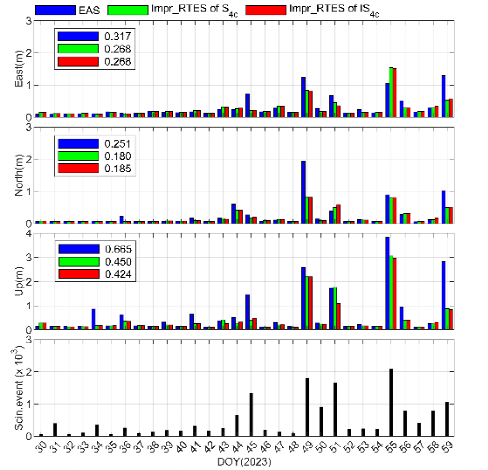
Fig.7 RMS statistics of GPS single-frequency kinematic PPP based on EAS, Impr_RTES of S4C, and Impr_RTES of IS4C models from January 1 to February 28 in 2023
3 Conclusions
To suppress the impact of GNSS receiver background noise on the ionospheric amplitude scintillation index S4c, this study proposes a new scintillation index IS4c to improve S4c based on the idea of de-mean and adaptive weight coefficient adjustment. The availability of IS4c is experimentally verified using the datasets derived from both ISMR and geodetic receivers.
Taking S4 derived from ISMR as the benchmark, the fluctuations of IS4c with low satellite elevation angles are generally consistent with those of S4, which can effectively suppress the effects of receiver background noise on S4c and reduce the probability of misjudgment in ionospheric scintillation events. Within the first nine months ISMR data in 2023 for the HNLW station, the average misjudgment rates of IS4c and S4c indexes are 3.7% and 11.7%, respectively, and the improvement rate of IS4c over S4c index reaches 69.9%, verifying the feasibility of IS4c index. For the geodetic GNSS receivers, IS4c index can effectively suppress the effect of receiver background noise on S4c. Experiments using consecutive 30 days data in 2023 from 20 GNSS stations equipped with four mainstream geodetic receivers indicate that the average improvement rates of IS4c over S4c for the JAVAD, LEICA, SEPTENTRIO, and TRIMBLE are 63.6%, 69.2%, 61.3%, and 61.4%, respectively. Meanwhile, two-dimensional IS4c maps generated by GPS L1 signals data collected at 1,363 stations in the range of 45°S-45°N and 60°E-180°E during the Tonga volcanic eruption on January 15, 2022, show better ionospheric scintillation monitoring performance than those of S4c maps. Besides, we also applied the IS4c in the Impr_RTES model for GNSS PPP. Experiments indicate that compared with EAS model, the Impr_RTES of S4c and Impr_RTES of IS4c can improve the PPP positioning accuracy by 15.5%, 28.3%, 32.3%, and 15.5%, 26.3%, 36.2% in the east, north, and up directions from January 1 to February 28 in 2023.
Acknowledgments
This work was supported by the National Natural Science Foundation of China (42274042; 42104029) and the Natural Science Foundation of Hunan Province, China (2023JJ20060).
Luo, X., Xie, A., Hu, J. et al. Improved amplitude scintillation index IS4cwith suppression of GNSS receiver background noise effects. GPS Solut 30, 112 (2026). //doi.org/10.1007/s10291-026-02080-2


